
Human cognition is not one continuous act of reasoning. We explore, execute, doubt, and reverse course. Judgment is the faculty that decides which mode the moment requires. Frontier models can produce plausible next steps; long-horizon discovery asks a harder question: should this line of thought continue at all? Knowing when to preserve uncertainty, overturn a belief, revisit discarded evidence, or commit is not more knowledge. It is control over thought itself.
We introduce Metacognitive Steering (MCS), which gives a frozen trillion-parameter model control over that process. During generation, a sparse neural controller reads the cognitive state from the model’s residual stream, selects a deliberative, methodical, or challenging stance, and writes a calibrated steering matrix back into the residual stream. The intervention changes how the model navigates an entire discovery trajectory while leaving every model weight untouched. It’s an exploration strategy over long-horizon trajectories, learned from the world’s best scientists.
The Problem
The file drawer is the training set we never had
Every scientist has a drawer full of failures: hypotheses scrapped, experiments that came back inconclusive, ideas shelved instead of chased. None of it reaches a paper. Papers report the path that worked, not the dozens that did not, and that omission is the whole problem between AI and science.
Reinforcement learning works in code and math because both hand you a verifier. Run the tests, check the proof, iterate ten thousand times, keep what passes. Science has no verifier. The deeper problem dates at least to Karl Popper: in The Logic of Scientific Discovery (1959), he argued that scientific theories are never empirically verifiable; they can only survive attempts at refutation. Experiments are expensive, results are noisy, and a negative result means either the hypothesis was wrong or a hidden variable was missed, with nothing in the data to say which. Scientists resolve that with judgment: dismiss this as noise, treat that as signal, persist inside the current framework or abandon it. It is causal reasoning under evidential and institutional pressure, and it requires holding a belief with no corroborating data long enough to go looking for data that does not yet exist.
Those decision points are edited out of the record before publication. Training on more papers cannot recover them. You have to catch judgment while it is still moving.
Stage One
Catch judgment in motion
So we built the instrument first. Aristotle is an AI research partner that working scientists use on their own novel, long-horizon problems: literature, hypothesis generation, analysis, experimental design. The output was never the point. The interaction was.

What makes the resulting dataset unusual is not its size, but its structure:
- It is born inside real scientific work. Qualified scientists are pursuing questions whose answers are not already in the training corpus, not completing decontextualized annotations.
- It preserves negative knowledge. Rejected ideas, weak evidence, failed searches and reasons not to proceed survive alongside successful conclusions.
- It makes judgment observable over time. Branches, revisions, dwell time and discarded evidence reveal the consequence of an early decision many steps later.
From those traces we extracted tens of thousands of contrastive nudge pairs: identical context, two completions that differ only in cognitive approach.
That contrast is key. A model can imitate what an expert says from imitation data alone. It cannot learn when to change its mind from reading answers, because the answers are what remain after the mind was changed.
Stage Two
Find the control surface
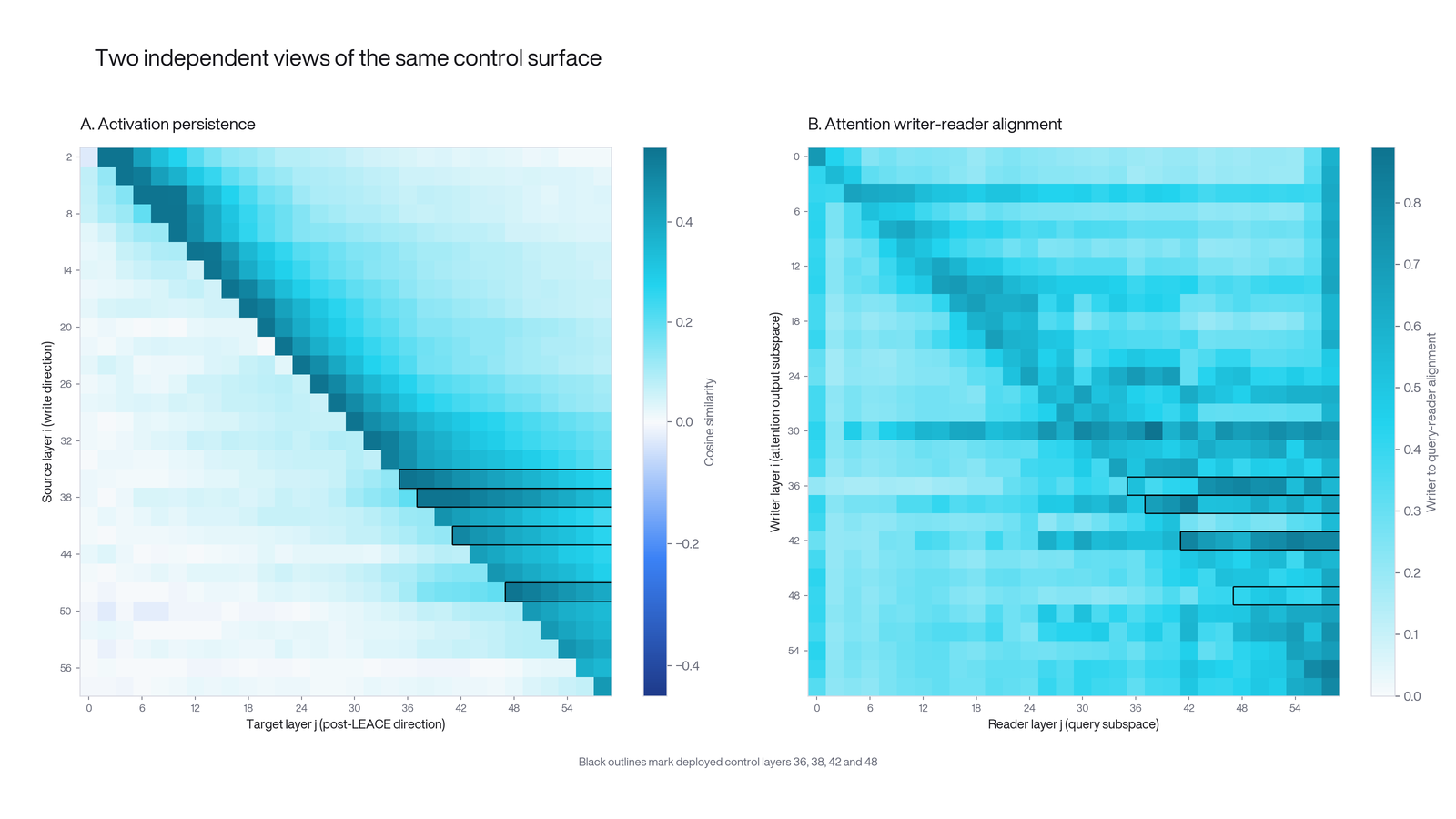
We held the scientific context fixed, changed only the cognitive intervention, and subtracted the resulting activations at every layer. Before measuring alignment, we erased the dominant direction shared by all interventions. What remains is not the generic fact that the model received an instruction, but the geometry of how it was asked to think.
The left panel of Figure 3 asks where that contrastive direction is written and how long it survives. A horizontal band means one source layer writes a direction that many later layers remain aligned to. Layers 36 and 38 establish the principal band; layer 48 carries the strongest late signature before output. Earlier layers appear to interpret the context. These layers set a configuration that persists.
Persistence alone could be inert. So the right panel tests the model’s weights, independently of the judgment dataset. Attention outputs write into the residual stream; later query projections determine what is read back. Their subspaces align above a random baseline, with layers 36 and 38 feeding the same late region and layer 42 emerging as an attention hub. The network is not merely storing the signal. Its attention geometry is organized to retrieve it.
The two analyses resolve different pieces of one mechanism. Activation identifies where cognitive stance is written and preserved. Attention identifies how downstream computation can transmit and read it. Together they expose a connected control surface: layers 36 and 38 establish the reasoning configuration, layer 42 coordinates access to it, and layer 48 carries its late activation signature. That convergence is why we steer all four.
That locates a possible channel. To ask whether it has coherent structure, we stacked the four hub layers and compared their singular values against a null that preserves each layer but breaks cross-layer coordination.
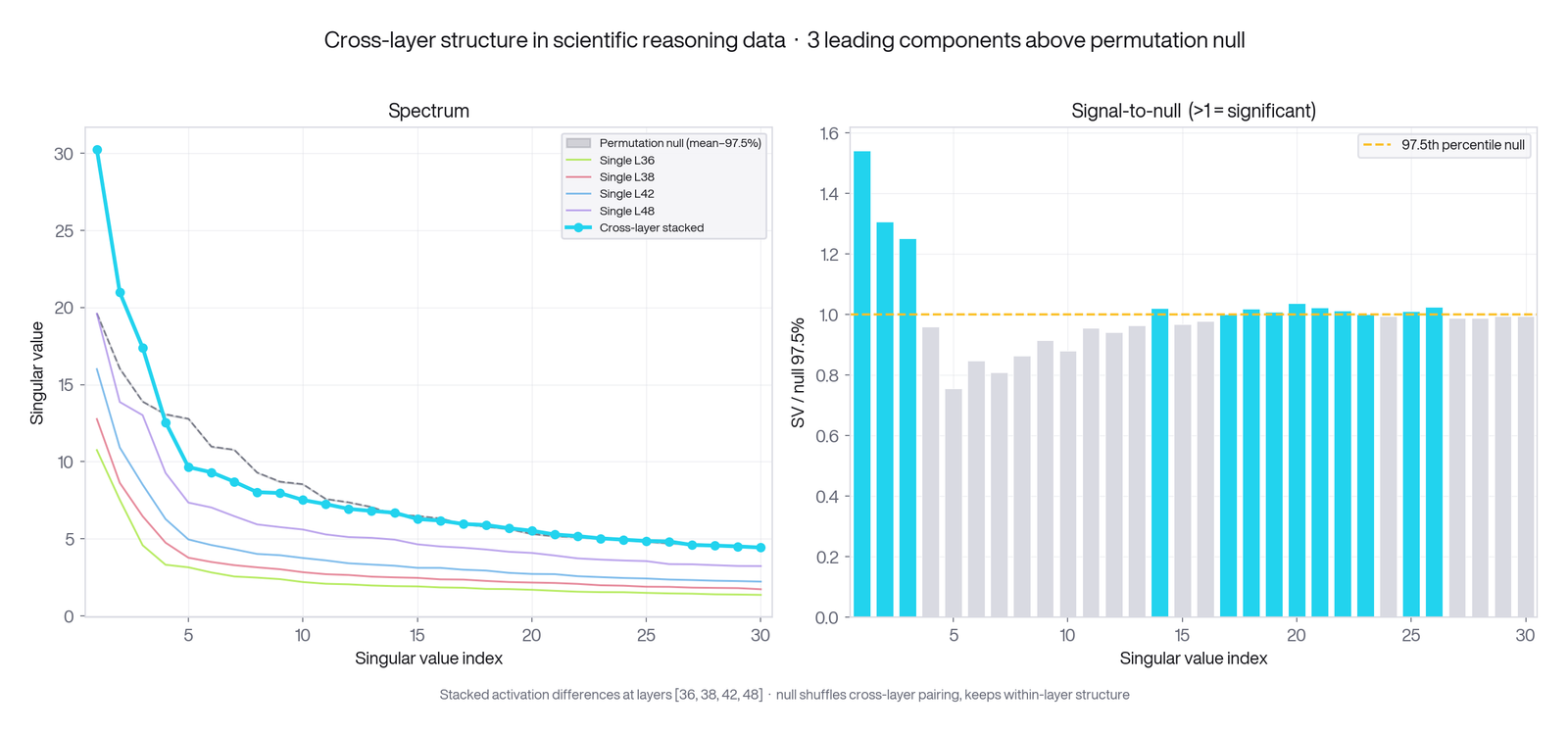
These singular values summarize coordinated structure across every contrastive pair in the analysis, jointly over all four target layers, rather than a handful of striking examples. Three leading components clear the cross-layer permutation null decisively, at 1.54, 1.31 and 1.25 times its threshold; the fourth does not. Then an independent, unsupervised clustering of absolute activations returns three states. Difference geometry and state geometry had every opportunity to disagree. They did not. The coincidence is not proof of a mechanism, but it is a precise place to intervene and try to break one.
Stage Three
Reasoning separates into control regimes
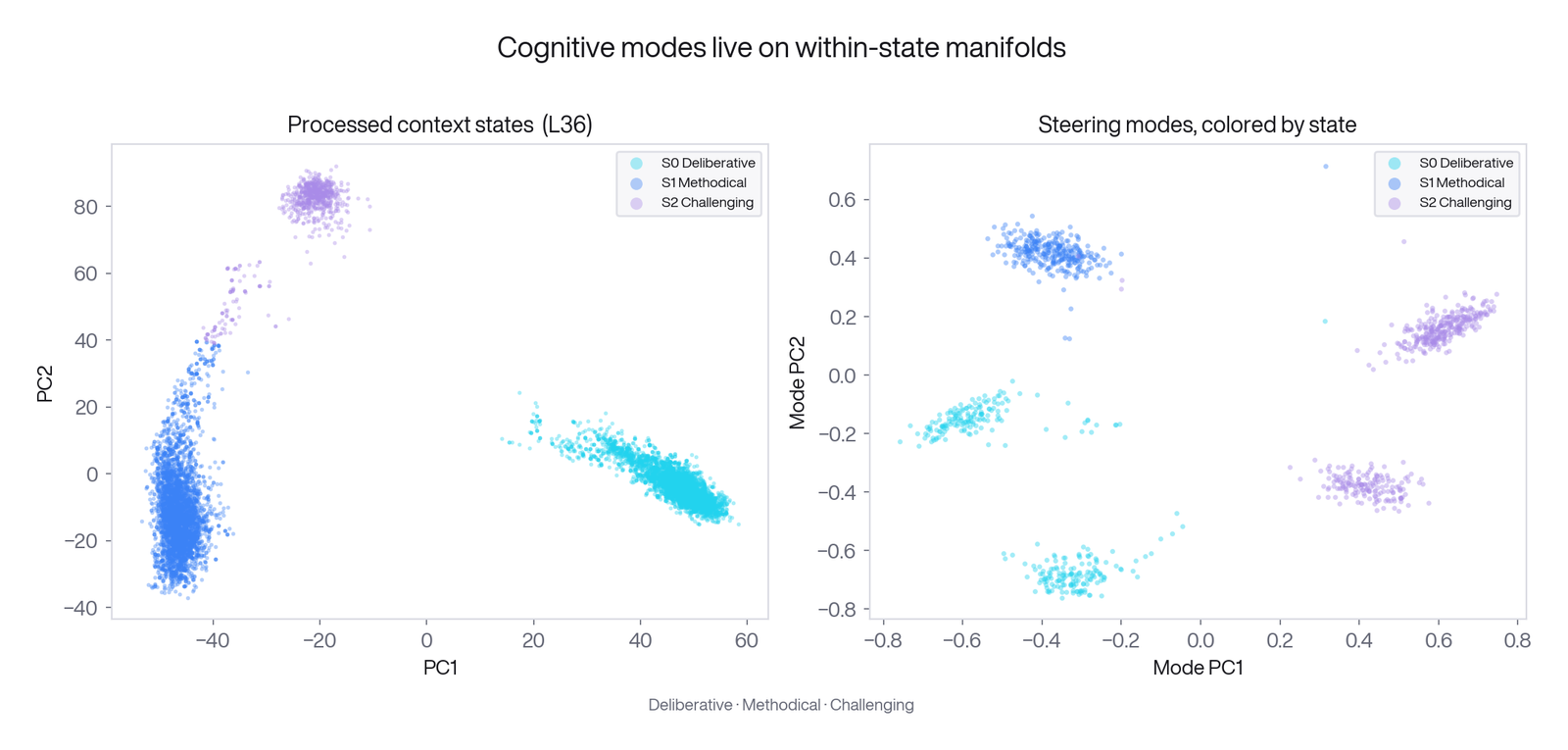
By layer 36, the model has already processed the prompt, evidence, tool results and trajectory history into a representation of the current research context. We capture that 7,168-dimensional state before steering and ask what kind of intervention it calls for. With no labels and no prompting, unsupervised clustering returns three cognitive regimes, each containing finer steering modes. The clusters were unsupervised; scientists assigned the functional labels afterward by reading the reasoning traces and observing each cluster’s behavior in controlled experiments.
| State | Stance | What it does | Geometry |
|---|---|---|---|
| Deliberative | Explore | Broad search, speculative branching, resisting premature commitment; oscillates internally between exploratory and cautious | Primary reasoning manifold |
| Methodical | Converge and execute | Numbered options, controls and metrics, falsification criteria, budget-aware commitment | About 85 degrees from Deliberative, near-orthogonal and safe to blend |
| Challenging | Scrutinize | Constraint enforcement, error flagging, pulling back after overextension | 130 to 142 degrees from the other two, so it opposes them |
That last row is the finding we did not expect. Challenging is not a flavor of deliberation but its geometric opposite: a brake circuit. The system therefore hard-routes between cognitive regimes and uses neural steering predictors to blend only among compatible modes within each one. Diluting a brake with an accelerator gives you neither. The state-to-mode correspondence is nearly deterministic, with a Cramér’s V of 0.993 across the high-signal subset.
The Mechanism
A sparse circuit can read and rewrite cognition
The mechanism begins with one unsteered pass. At layer 36, a sparse readout looks into the model’s processed research context and identifies its cognitive regime. The signal is unexpectedly compact: ten selected neurons recover the three regimes with approximately 99 percent cross-validated accuracy. For deployment, we use a broader stability-selected readout and a dedicated 20-neuron interrupt detector that can route immediately into challenge when its threshold is crossed.
The state does not select a canned persona vector. It opens a local control surface. A 30-neuron within-state predictor chooses the blend between exploratory and cautious deliberation; methodical routing is deterministic; and a 75-neuron predictor resolves the challenging modes. Their probabilities mix contrastive directions into a four-row steering matrix, damped when the context is out of distribution, scaled to 8 to 12 percent of the activation norm, and written into layers 36, 38, 42 and 48 before logits are produced.
1. CONTEXT   unsteered prefill -> processed research state at L36
2. READ      sparse state neurons -> cognitive regime
3. PREDICT   within-state neural controller -> mode blend
4. WRITE     mode blend -> vectors at L36, L38, L42, L48
5. APPLY     residual[-1] += alpha * v, on every decode step
No gradient touches the model. Its trillion parameters remain frozen and bit-identical between steered and unsteered runs. At every decode step, the system reads the context the model has formed, predicts the cognitive move that context calls for, and writes it back into the circuit. The weights stay fixed. The direction of computation changes.
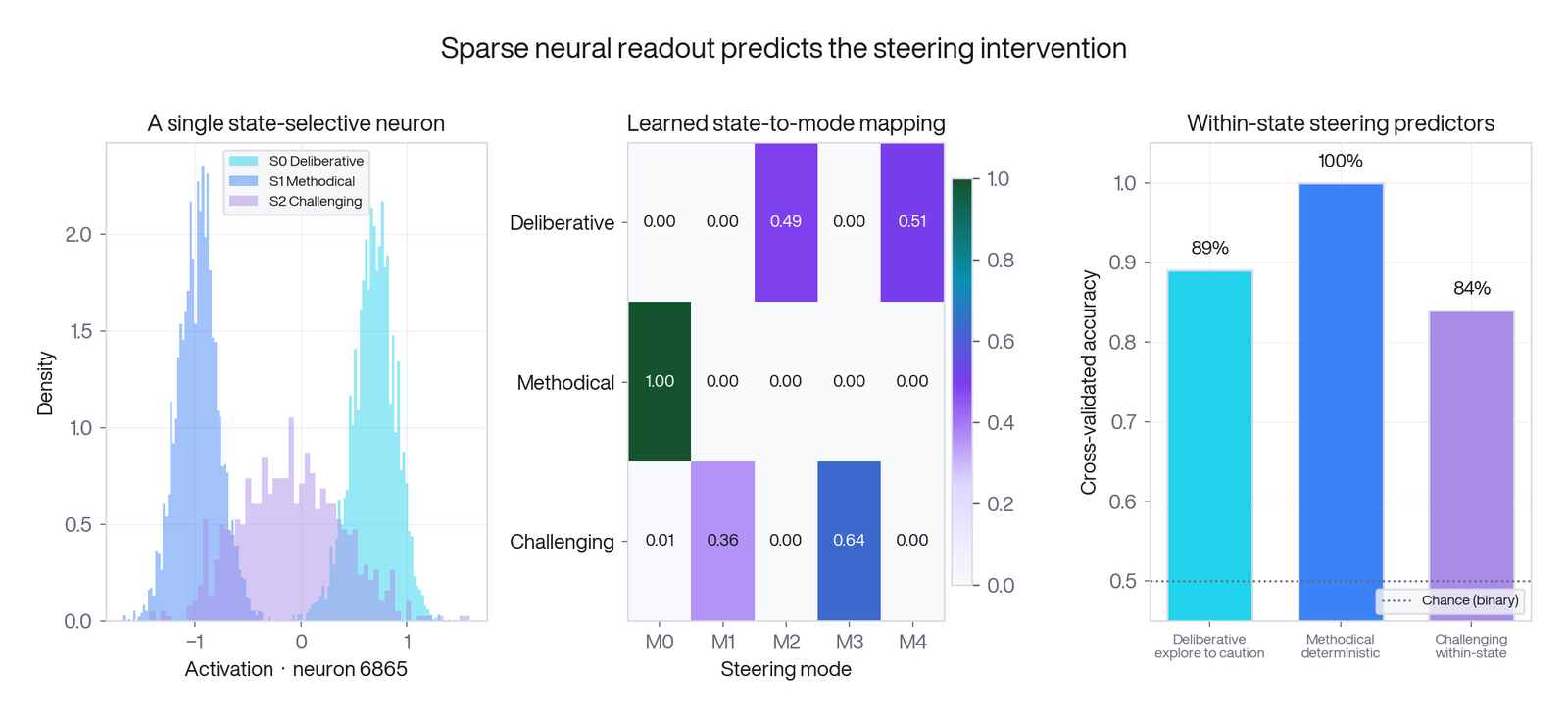
Figure 7 opens that loop during a closed-loop interpretability task. The model is effectively working on itself: with access to our ML research team’s full codebase and interpretability results, it is asked to turn its own layer-36 state detector and steering vectors into a training procedure using web search, code execution, data analysis, branching and notes.
Each cycle is one reasoning step. The header shows the agent action under way. White activity carries the unsteered read pass to layer 36, where the sparse controller neurons identify the cognitive regime. The predicted steering matrix then separates into four colored vectors, crosses the network, rotates into layer orientation and lands at layers 36, 38, 42 and 48. The final colored pass shows the intervention propagating through the same frozen model.
Evidence
What changes when you steer
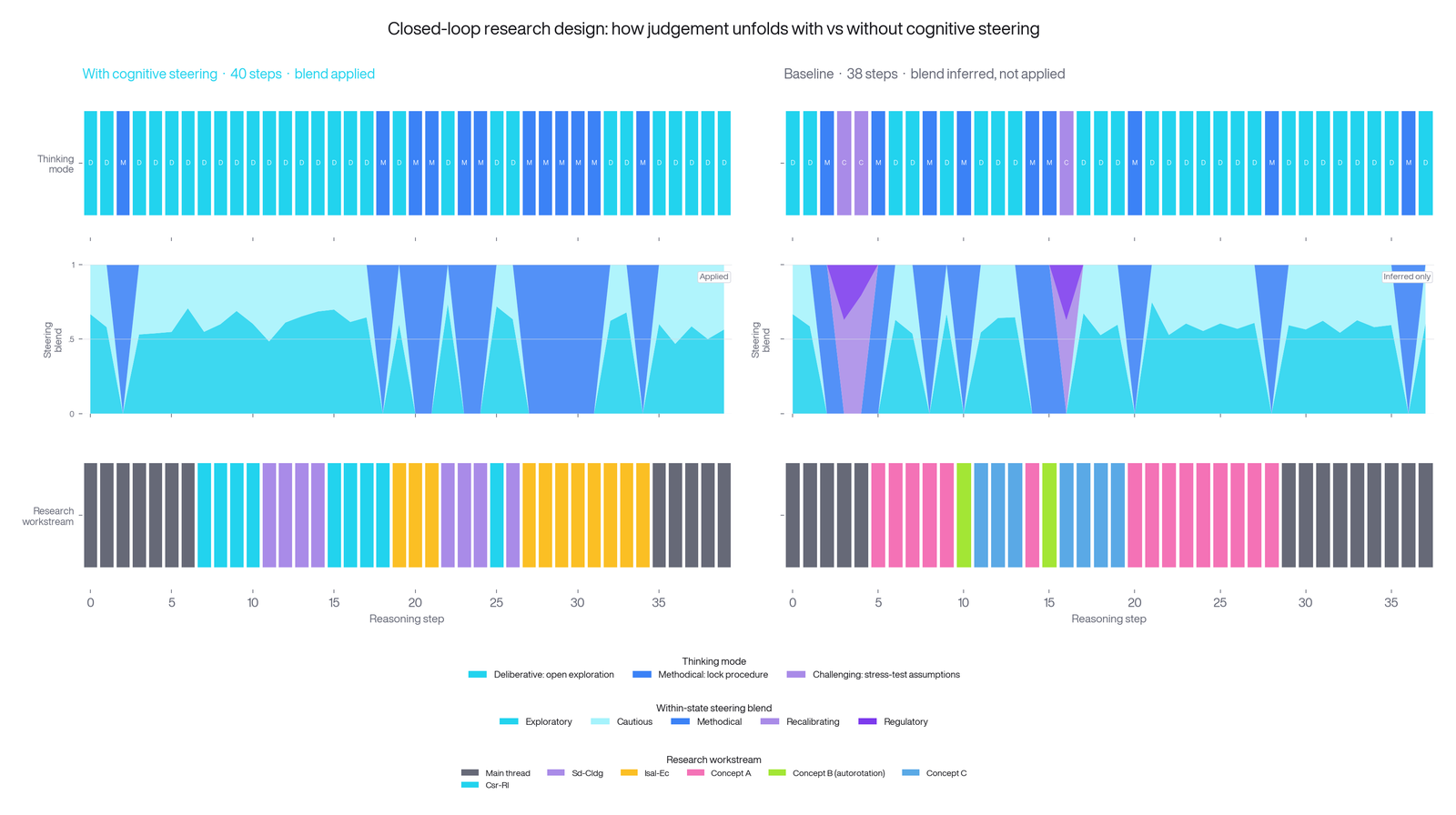
We ran two small matched process probes with different tasks and different tool sets. Same frozen weights, same prompt, same tools; the only difference within each pair is the injected vector. These are not benchmarks of answer quality. They let us watch whether steering changes the shape of judgment.
In the interpretability task, the model must turn its own internal-state findings into a closed-loop training proposal. The baseline samples several branches, then settles into an additive synthesis. The steered run keeps alternatives alive later, develops one approach far enough to expose its failure mode, and then kills it: directly optimizing the sparse detector could invite representation gaming. It preserves the reason for rejection, returns to first principles and commits to a different proposal with explicit falsification criteria. The striking behavior is not exploration alone. It is pruning after deep investment.
The second probe changes domains completely. The model must design a self-landing rocket under coupled propulsion, stability, regulatory and fabrication constraints, with access to CAD, six-degree-of-freedom simulation, Python optimization and Monte Carlo analysis. The baseline chooses autorotative recovery early and develops it linearly. The steered run continues switching between propulsion, descent, avionics, structures and certification as constraints propagate between them. It commits briefly when a procedure must be fixed, then reopens the design when local decisions threaten the whole system.
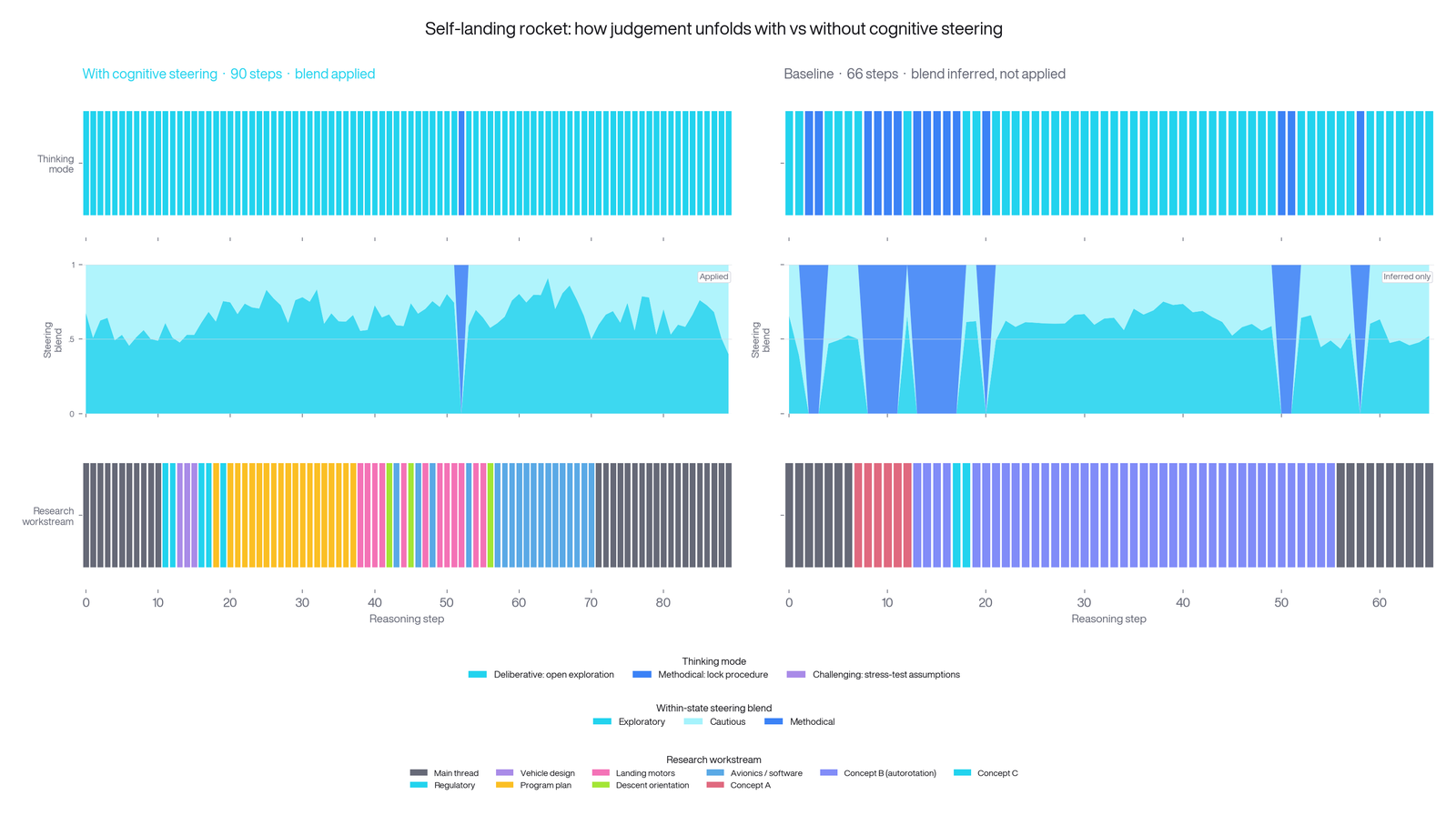
Across both probes, the same signature appears: more switching between developed branches, later commitment, and a willingness to discard work after learning enough to see why it fails. That does not establish that every conclusion is better. It shows that a small internal intervention can change the temporal structure of inquiry in the intended direction. The next tests leave the controlled setting.
The System
Columbus-1 remembers what research usually forgets
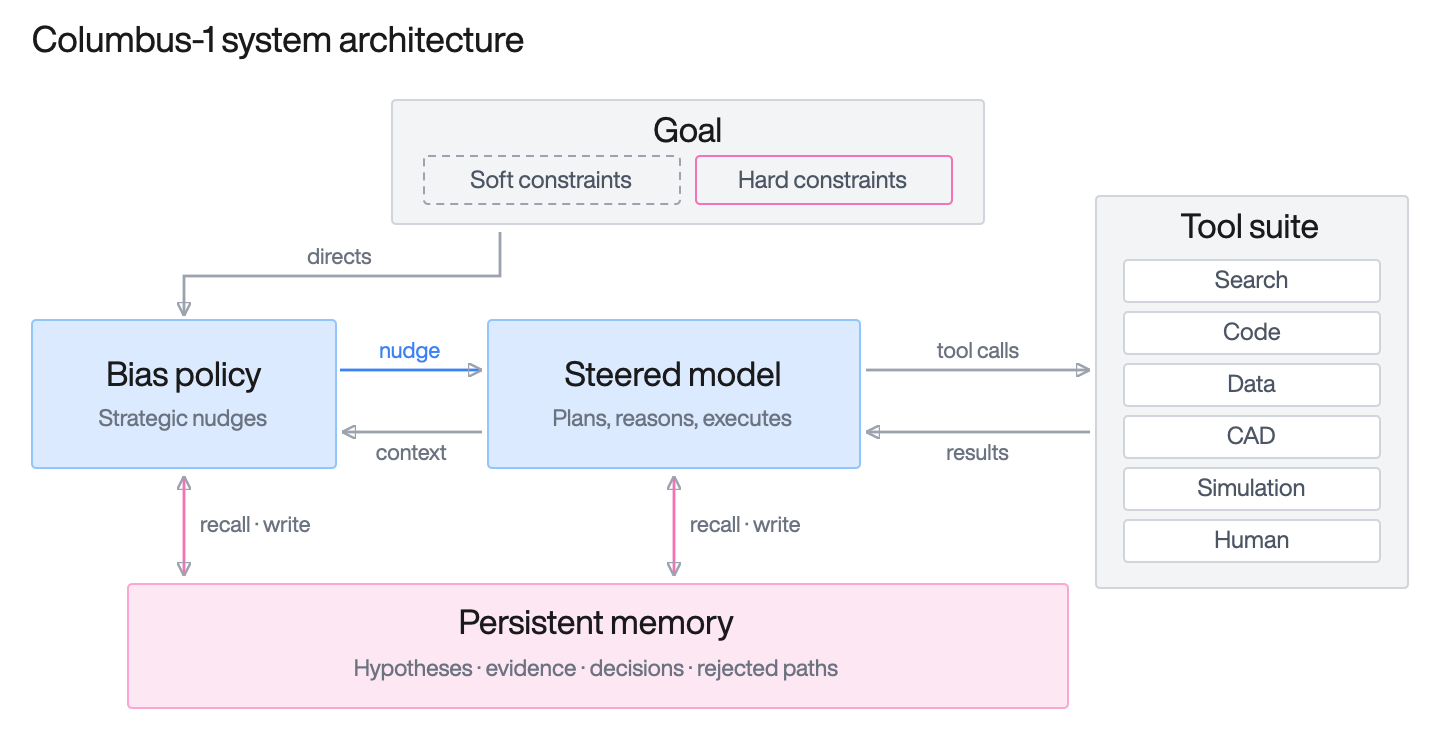
Columbus-1 is our first autonomous research system built around Metacognitive Steering. A 32B bias policy oversees hierarchical planning and exploration, injecting strategic nudges into the main reasoning model much as a scientist steers a collaborator. The neural controller governs the cognitive move required now; a persistent semantic memory graph preserves hypotheses, evidence, decisions, methods, facts and rejected paths across the investigation.
The memory graph is not an archive. By linking support, contradiction and causal structure, it lets Columbus-1 revisit weak signals, reflect on competing hypotheses and generate new ones from what the investigation has already learned. The graph supplies continuity; Metacognitive Steering supplies judgment. Together they turn a model that answers questions into a system that can sustain discovery.
We tested Columbus-1 where judgment has consequences: a cyber discovery problem and a rocket science problem.
Result One
Bluetooth zero days
In partnership with Xchg Labs.
Bluetooth is the invisible network around us. It is the short-range wireless standard that lets devices discover, identify and exchange data with one another before most people know a connection exists. Phones, laptops, cars, industrial controllers and medical gateways all use it. Roughly 5.4 billion Bluetooth-enabled devices shipped in 2025.
At the center of the Linux side of that ecosystem is
BlueZ, the official Linux
Bluetooth protocol stack. Its userspace daemon, bluetoothd, processes data arriving
over the air. We pointed Columbus-1 at BlueZ precisely because it is extremely difficult to find new
vulnerabilities there, and harder still to find one at the radio boundary before authentication or
pairing.
The difficulty is not just the size of the codebase. Vulnerability research is a multiplying search tree. Every suspicious copy, parser and state transition branches again at reachability, trust boundaries, allocator behavior, build configuration and exploit mitigations. Most paths fail only after expensive validation. The number of plausible chains grows at every step, while the signal that matters can begin as one unremarkable line of C.
Current frontier models tend toward mode collapse on that tree. Over a long investigation, independent runs return to the same attack paths, the same bug classes and the same locally plausible explanation. Reinforcement learning makes strong reasoning paths more reliable; in open-ended discovery, it can also make them attractors. The model keeps searching, but it keeps searching the same place.
Columbus-1 was different in this evaluation because it could preserve the branches. Its memory graph retained weak signals, rejected paths and unresolved reachability questions across the investigation. Metacognitive Steering moved the system between broad codebase exploration, focused source analysis, adversarial exploitability review and methodical sanitizer validation. It did not only accumulate candidates. It killed three false positives, demoted a real but remotely unreachable overflow, and returned to the paths that survived challenge.
The result was ten crash sites corresponding to eight confirmed attacker-reachable findings. Xchg Labs independently rebuilt the proofs of concept, reproduced the faults and confirmed the findings against BlueZ 5.86. The set included stack and heap corruption, a filesystem race and allocation-failure defects; one finding crossed the radio boundary with no pairing.
Then Columbus found the one that changes the scale of the result. While
scanning nearby devices, BlueZ copied an attacker-controlled advertised name into a fixed 250-byte stack
buffer inside the privileged bluetoothd daemon and wrote past its end. The input arrives in
Bluetooth advertising data, before authentication, before pairing and before the target has agreed to
anything.
The highest-severity zero day is a zero-click, full-chain remote code execution vulnerability. No click. No pairing. No connection request. A nearby attacker can compromise the target over the air without the victim doing anything, then execute code with full access to the compromised system. A reliable chain with that combination of reach, silence and control is a nation-state-tier capability. The victim can be owned before the operating system has a reason to put anything on screen.
Disclosure: Xchg Labs contacted the BlueZ maintainers on 6 July 2026 at 04:16 UTC from contact@xchglabs.com and remains available to help.

Result Two
A rocket that lands itself
We gave Columbus-1 a problem that reads like a contradiction: a ten-foot rocket that launches conventionally and lands propulsively on commercially available G-class solid motors. Solid motors cannot be throttled and cannot be shut off. Once lit, each one burns to completion. The vehicle has to be landed by choosing ignition instants while attitude, velocity, wind, motor dispersion and ground contact all move at once, and a few hundred milliseconds of error turns the landing burn into either a crash or a second launch.
Columbus-1 was not assisting an engineering program. It was running one. Given the budget, procurement constraints and schedule, it selected the architecture, generated the parametric CAD and fabrication-ready STL, STEP and DXF files, and designed the motor cassettes, avionics structures, landing-leg attachments and energy-absorbing hardware. The fabrication team sent feedback over iMessage; Columbus-1 revised the design and issued the next instructions. Humans ran the printers. Columbus-1 ran the engineering.
In parallel it wrote the flight software and flew it in an OpenRocket ascent model coupled to a closed-loop six-degree-of-freedom landing simulation: aerodynamics, wind, motor dispersion, ignition uncertainty, thrust-vector control, cold-gas attitude control, touchdown dynamics, noisy multi-rate sensors. A SpaceX propulsion engineer and a PhD avionics specialist reviewed the environment, the assumptions and the results. The architecture and control logic survived that review with no corrective intervention.
Then it found the rule nobody gave it. Landing slowly is the wrong objective. A vehicle can arrive gently and still be thrown back into the air by the impulse left in a burning motor, so arrival velocity and remaining impulse have to be optimised together. Two more followed: stabilise attitude early in descent, before terminal propulsion, and stage motors on predicted time-to-contact and remaining impulse rather than fixed altitude thresholds. None of it was supplied. It came out of failed simulations, competing controller hypotheses and repeated revision, and it became a phase-aware landing architecture that lands safely in 99 percent of 100 fully dispersed runs.
Weeks from an apparently impossible constraint set to reviewed simulation, manufacturing files, flight software and hardware under construction. The organisational change is already here: this is not an engineer using AI, it is a research system running an engineering program and directing humans to build it.
Outlook
Now what
The missing piece to scientific discovery is not another corpus of papers. It is the judgment data papers leave out: what scientists notice, reject, revisit and change their minds about before the answer is known. We are building that dataset across scientists, disciplines and multi-day research programs, connecting context, cognitive stance, decisions and real outcomes.
Columbus-1 is the first system built on that compounding loop: scientist data becomes control, control changes the investigation, and each investigation produces new judgment data. Every use preserves more of the reasoning papers discard. Every new trace makes the next investigation better. The product becomes the data engine.
At scale, this dataset can teach models what pretraining never could, and with far greater sample efficiency: how to direct inquiry while the answer is still unknown. The result is not a better assistant. It is a research system that notices the anomaly, designs the missing instrument and runs the experiment that makes the invisible visible. Today that means Bluetooth parsers and landing burns. Tomorrow it means autonomous laboratories working on antibody therapeutics, genetic medicines and questions nobody has learned how to ask yet.
There is no AI scientist today. There are systems that imitate the products of science with increasing fluency and no idea when to stop believing themselves. The difference is not knowledge. It is knowing when to change your mind. That leaves a trace, in a specific place and in a specific direction, and it can be learned.
We are a small team based in San Francisco. If you're interested in joining us, please reach out research@autopoiesis.science.
Research Team
Vincent KarpfJiehao XingJialing SongJoseph Reth
With additional support from Eike Gerhardt, PhD, Lawrence Callahan, PhD, Anna Butz, Lucas Dondertman, Eina Gerhardt, Tran Huynh, David Lee, Royce Moon, Tyler Peña, Alexandra Reth, Mim Romyanont, Aaron Sacks, Audrey Wang, and Jennifer Yoon.
Thanks to Informed Ventures (formerly GSR Ventures), Alpaca VC, VitalStage Ventures, Cross Atlantic Angels, Adam Grosser, Mike Malhkow, Ally Warson, Hiro Muzushma, Tomas Urena Munoz, and Vanessa Cann.
Autopoiesis: From Greek “auto” (self) + “poiesis” (creation).